Publications
Hybrid surgery in hernias: Our experience
Introduction: Hybrid surgery is a procedure in which laparoscopic and open surgical steps are used for a better outcome to the patient. The aim of this study is to identify the factors that necessitated hybrid surgery in cases of hernia. Materials and Methods: It is a retrospective narrative study of 69 patients with hernia, who […]
READ MORETAPP INGUINAL HERNIA REPAIR
TAPP Inguinal Hernia Repair Patient Selection for TAPP Inguinal Hernia Repair Difficult cases: Direct or small indirect primary hernias in lean and thin subjects are the best during learning curve. Anesthesia General anesthesia Skin Preparation No studies are there assessing preparation for hernia surgery, but as with other surgical procedures, there is no difference in […]
READ MOREEndoscopic Ectopic Thyroidectomy
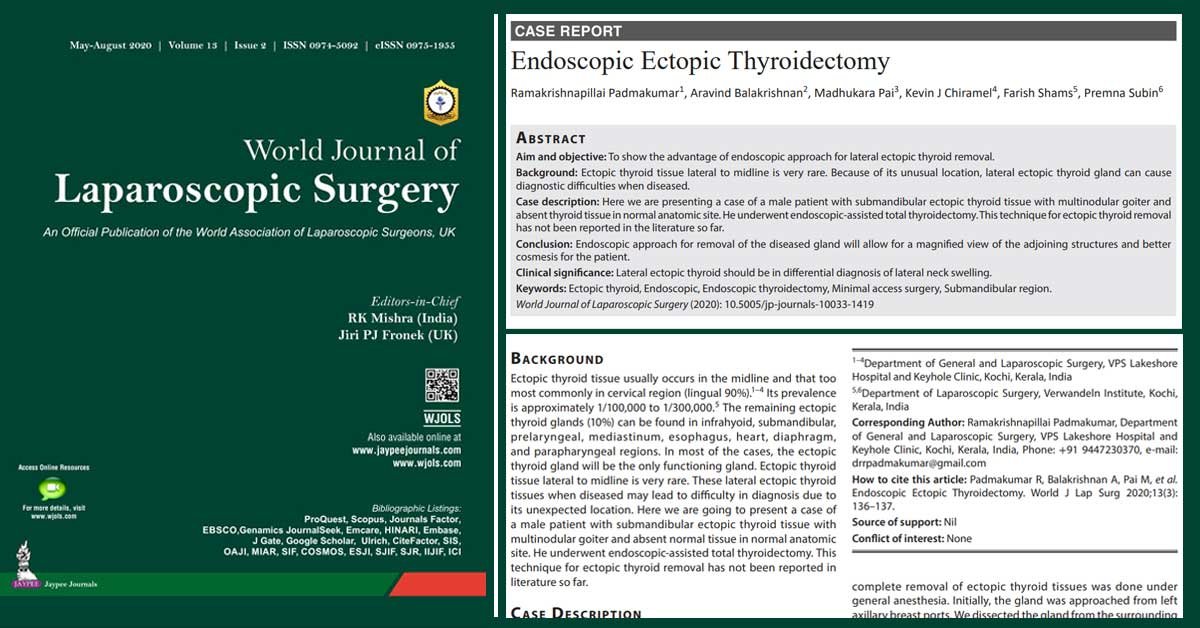
Endoscopic Ectopic Thyroidectomy – available from: https://www.wjols.com/doi/WJOLS/pdf/10.5005/jp-journals-10033-1419 Ramakrishnapillai Padmakumar1, Aravind Balakrishnan2, Madhukara Pai3, Kevin J Chiramel4, Farish Shams5, Premna Subin6 Abstract Aim and objective: To show the advantage of endoscopic approach for lateral ectopic thyroid removal. Background: Ectopic thyroid tissue lateral to midline is very rare. Because of its unusual location, lateral ectopic thyroid gland […]
READ MOREManagement of polycythemia vera by endoscopic parathyroidectomy

Padmakumar R, Chiramel KJ, Pai M, Shams F, Subin P. Management of polycythemia vera by endoscopic parathyroidectomy. J Appl Hematol [serial online] 2020 [cited 2020 Nov 20];11:204-7. Available from: https://www.jahjournal.org/text.asp?2020/11/4/204/300771 Contents Abstract Polycythemia vera (PV) is a hemotologic disease. Majority of persons with Polycythemia vera, essential thrombocythemia and primary myelofibrosis show the Janus kinase (JAK) 2 gene– […]
READ MOREPublications
Vitamin D deficiency – Surgeon’s Perspective: Dr R Padmakumar et al. Laparoscopic Hernia Repair – How to Learn at Ease Successful bowel surgery in patient with hemoglobin 2 g/dL without blood transfusion “PK Band” in Laparoscopic Hernia Repair Endoscopic Ectopic Thyroidectomy Management of polycythemia vera by endoscopic parathyroidectomy Total endoscopic excision of branchial cyst in […]
READ MORE“PK Band” in Laparoscopic Hernia Repair

Ramakrishnapillai, P., Gupta, S., Pai, M. et al. “PK Band” in Laparoscopic Hernia Repair. Indian J Surg (2020). https://doi.org/10.1007/s12262-020-02088-z Abstract Laparoscopic inguinal anatomy detail is different from that is necessary for open hernia surgery. ‘PK Band’ is a condensation of areolar tissue lateral to inferior epigastric vessels on either side. It extends fromarcuate line to apex of triangle of […]
READ MOREInguinal Anatomy with Peritoneum Incised
Previous Page – Inguinal Anatomy with Peritoneum Intact After the peritoneum is dissected away, six additional structures need to be identified. They are Pubic Crest: It helps in getting orientation. Beware of small veins overlying. If they bleed entire vision gets spoiled. Iliopubic Tract: The iliopubic tract is a thick fibrous white tract which runs […]
READ MOREInguinal Anatomy with Peritoneum Intact
Anatomy of Inguinal Region – Previous Page With the introduction of the laparoscope into the abdomen, five important landmarks can be identified in the infra-umbilical region. Inferior epigastric vessels Medial umbilical ligament Spermatic vessels Vas deferens Trapezoid of disaster Inguinal Anatomy with Peritoneum Intact Inferior epigastric vessels The inferior epigastric artery is prominently visualized during […]
READ MOREInguinal Region – Anatomy, Part 2
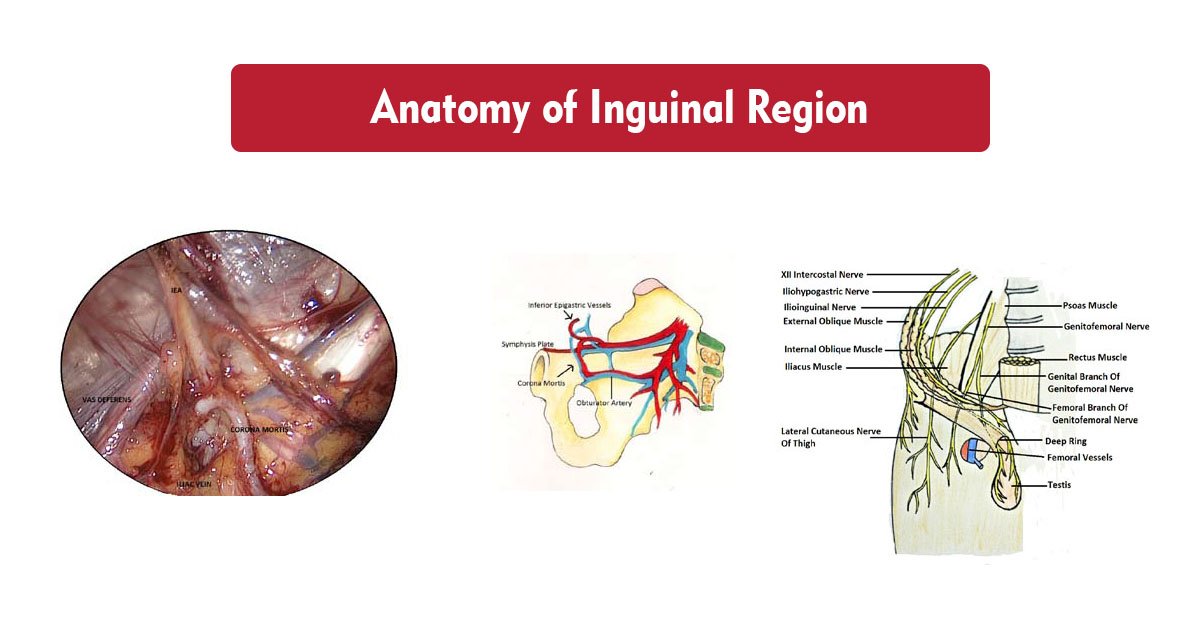
Anatomy of Inguinal Region – Previous Page Transversalis Fascia (of Gallaudet) This fascia is a two layered structure (bilaminar). The anterior layer is adherent to the rectus abdominis muscle. The posterior layer lies in between the anterior layer and the peritoneum. It divides this space into an anterior (vascular space) and a posterior (Space of […]
READ MOREInguinal Region – Anatomy, Peritoneal Landmarks, Infraumbilical Fossae – Part 1
Anatomy of the Inguinal Region The ‘Myopectineal Orifice of Fruchaud’ All groin (inguinofemoral) hernias originate in a single weak area called the myopectineal orifice. This oval, funnel-like, ‘potential’ orifice formed by the following structures, makes the ‘myopectineal orifice of Fruchaud’.-Henry Fruchaud Boundaries Superiorly Internal oblique and transversus abdominis muscles. Inferiorly Superior pubic ramus. Medially Rectus […]
READ MORE

-
Anal Fissure Treatment
-
Gynaecomastia Treatment
- Piles / Hemorrhoids Treatment
- Varicose Veins Treatment
- Laser Treatment for Varicose Veins
- Diabetic Foot Treatment